Following Baseball Prospectus' top prospect lists, the 'Before They Were Pros' series provides reports on the top prospects in baseball from their time in high school at PG events.
As part of Perfect Game's partnership with Baseball Prospectus, David Rawnsley and Patrick Ebert will be conducting a “Before They Were Pros” series, providing scouting reports on some of the top prospects in baseball from when they were in high school attending PG events. This six-part series (one for each division in MLB) will appear once Baseball Prospectus has provided their own detailed scouting reports of the top prospects, team-by-team, as part of their own series.
We continue with a look at the American League Central. Be sure to read Baseball Prospectus' features on each of the five teams:
Twins | White Sox | Indians | Tigers | Royals
And here are links to the other 'Before They Were Pros' series already conducted:
NL East | NL Central | AL East | NL West
Minnesota Twins
 Kohl Stewart – RHP
Kohl
Stewart's baseball career took off, not surprisingly, when he stopped
playing football.
The
Houston area native was best known as a prep high school quarterback
at St. Pius X High School. He threw for 3,167 yards and 30 touchdowns
as a junior and committed to play quarterback for Texas A&M. The
thought of playing quarterback for the Aggies in 2012 was as good as
it got. Their previous quarterback, Ryan Tannehill, had graduated to
the Miami Dolphins. Their present quarterback was Johnny Manziel.
They were moving to the all-hallowed SEC. That was heady stuff.
Stewart
hadn't been seen much outside of the Houston area when he went to the
2012 PG National Showcase in Minnesota. After throwing what PG's Ben
Ford described as the best bullpen he'd ever seen a high school
pitcher throw, Stewart's back tightened up and he was unable to take
the Metrodome mound. He was able to recover from that mild set back
and make a number of national appearances late in the summer,
including the 2012 PG All-American Classic. Stewart would regularly
top out at 94-95 mph at these events and flash his power mid-80s
slider, although he tended to overthrow this pitch at times.
Stewart
was enjoying another very successful football season in the fall of
his senior year, throwing for 2,560 years and 28 touchdowns and
adding another 483 years on the ground when his season ended in early
November when he landed awkwardly on his right shoulder after being
tackled. There was significant concern in the scouting community,
along with an over abundance of Texas-sized rumors, about Stewart's
health as the baseball season started.
Stewart
eased into the season slowly but ended up throwing so well and being
so dominant that the shoulder injury became deep background by draft
time. Stewart ended up posting a 5-1, 0.18 record, allowing only one
earned run and 13 hits in 40 innings while striking out 59 hitters.
Stewart also hit .384-10-34 for good measure to remind scouts of his
overall athletic ability. His stuff was consistent, with regular
mid-90s velocity and his signature slider showing big depth to go
along with its knee-buckling power. There was no doubt that Stewart
was going to be a top 10 selection and very little discussion about
his potential football career, either.
The
Twins grabbed him with the fourth overall pick, making him the first
high school player selected, one pick ahead of Clint Frazier and the
Indians. Stewart agreed to a $4,544,000 signing bonus almost
immediately. – David Rawnsley
 Stephen Gonsalves – LHP
Stephen
Gonsalves success in pro ball thus far is a testament to the often
forgotten and nearly impossible to measure role of a team's minor
league coaches in his development.
A
native of San Diego, Gonsalves was a well known player nationally by
the time he was a sophomore and was a highly ranked player from first
time that the Perfect Game class of 2013 rankings were posted. He
grew to his full 6-foot-5 height early and was always superbly
coordinated. In fact, he was considered almost as much of a position
prospect as a pitching prospect at one point, even playing as an
outfielder at Cathedral Catholic, one of the top high school programs
in the country, as a freshman.
But
Gonsalves ticket to the next level was his left arm and velocity
always came easily for him. He hit 90 mph for the first time at a
Perfect Game event at the Sunshine West Showcase at the end of his
sophomore year. With his athleticism, silky smooth arm action and
prototype pitcher's build, the word "projectable" followed
Gonsalves around like the number on the back of his uniform jersey.
Gonsalves
backed up that on the mound as well, going 9-0, 1.03 for Cathedral
Catholic as a sophomore and 10-0, 1.73 as a junior. He was frequently
talked about as a potential first rounder when his draft year came
around.
One
thing was becoming increasingly worrisome to those who had tracked
Gonsalves from early in his career. He really struggled throwing a
curveball and it was getting worse, not better. He slowed his body
significantly and had an early release on it that is universally
known in the scouting world as "casting" the ball. On a pro
grading scale it was a 20 pitch. The most worrisome aspect was that
Gonsalves should have had at least a decent curveball; he was
athletic, he played for top programs with well respected coaches and
it wasn't as if he was afraid to use the pitch, he probably threw it
too often.
During
his senior year Gonsalves and the entire Cathedral Catholic team
struggled. Pegged by some as the top team in the country and
featuring three PG All-Americans on their pitching staff in Gonsalves
junior Brady Aiken and sophomore Drew Finley, the team finished
20-13. Gonsalves went 6-2, 2.19 with mediocre ratios compared to his
previous two seasons. His draft stock was plummeting and it looked
like the University of San Diego staff would get a chance at fixing
his curveball before professional ball.
The
Twins took a shot at buying low on Gonsalves and picked him in the
fourth round, eventually signing him to a $700,000 bonus.
This
scout had seen Gonsalves pitch at least six times as a high schooler.
I ran into him by coincidence on a back field at the Red Sox Complex
during the 2013 WWBA Underclass World Championship, where the Twins
and Red Sox were playing an instructional league game. I couldn't
believe the difference in Gonsalves curveball. Instead of being in
the upper-60s, it was mid-70s and had some hair on it. If Gonsalves
had thrown that pitch in high school he would have been a lock-down
first rounder. The Twins pitching coaches had done their job and done
it very well. – David Rawnsley
Chicago White Sox
Chris Beck – RHP
Beck's
peak velocity at a Perfect Game event occurred the summer before his
senior year, pitching for the powerful Gerogia-based Team Elite
program at the 2008 17u WWBA National Championship. There the
projectable 6-foot-3, 190-pound righthander worked at 82-88 mph, but
the ease in which he threw and potential for additional velocity as
he gained more strength to his frame was evident.
Like
so many pitchers who blossom while in college, it was near impossible
to project just how far the strength gains would allow Beck to
improve. His talent was evident enough in high school for him to be
ranked 326th in the 2009 class, but his game elevated to a
much higher level at Georgia Southern.
Beck's
game took off during his sophomore year in college, and took another
step forward during the summer that follow playing on the Cape. He
entered his junior year as a likely first-round pick, although he
didn't carry the success from the previous year over. Beck was still
good enough to be ranked the 41st overall prospect leading
up to the 2012 draft.
Here's
his pre-draft report from Allan Simpson:
Beck’s
raw stuff has been consistent with where it was last spring, when he
went 9-5, 3.23 with a Southern Conference-high 109 strikeouts in 103
innings, but it has not been as electric as it was last summer in the
Cape Cod League (3-2, 2.12, 51 IP/41 SO), when he surged to
prominence as one of the top arms in the 2012 college class by
featuring three average to above-average major-league pitches in a
94-96 mph fastball, 80-83 mph slurve-like breaking ball and 84-mph
straight change. This spring Beck’s fastball has been consistently
91-94 mph leading to a 4-4, 3.82 record and a 18-87 walk-to-strikeout
ratio. Beck has altered his delivery to more of an overhanded slot
which may have led to the slight drop in velocity. Beck’s slider
has still been a solid pitch at 82-84 mph when he gets on top of it
and creates two-plane break, and he continues to throw a solid changeup.
Beck
played alongside Victor Roache in college, giving Georgia Southern a
rare dynamic duo for scouts to follow during the spring of 2012.
Although Roche's junior season was cut short due to a broken wrist,
he still was drafted late in the first round by the Brewers. Beck,
who was also believed to be a potential first-rounder, still went in
the second round despite not being as sharp that spring. – Patrick Ebert
Micah Johnson – 2B
Prior
to attending the University of Indiana Johnson was lightly recruited
out of an Indianapolis area high school. He showed the requisite
tools to play at the Division I level, and received complimentary
reports from the Perfect Game scouting staff at the tournament events
he attended, playing mostly with the Lids Indiana Bulls travel
program.
At
the time Johnson hit from both sides of the plate, showing a line
drive swing path, quick hands and good bat speed. His eventual
defensive home was somewhat in question, but he was a good enough
athlete to move between the infield and outfield relatively
seamlessly.
It
didn't take long for him to make an immediate impression in college,
hitting .312 with 11 home runs for the Hoosiers his freshman year
while playing third base and .335 with three home runs playing second
base as a sophomore. Johnson gave up switch-hitting to focus on his
approach and swing from the left side of the plate, one more positive
aspect of his prospective value.
Unfortunately
he never got into the full swing of things during his pivotal junior
year due to an elbow injury that relegated him to serving as
Indiana's designated hitter. Here's his pre-draft report from the
spring of 2012:
Johnson
began the 2012 season as Indiana's DH, prior to having surgery on his
throwing elbow in early March. He recently returned to action and
understandably was a little rusty at the plate from his long layoff,
and finished the regular season by hitting just .203-1-8 in 20 games.
He may have to get on a hot streak at the plate in the Big Ten
tournament in order to justify his current standing as a potential
top-10-round pick. Nonetheless, Johnson’s athleticism is readily
evident with his quick-twitch actions and strong, well-proportioned
build. He has good strength throughout his 5-foot-11, 190-pound
frame, and his raw speed (6.65 second in the 60) is a critical part
of his game … While there is modest power in his quick lefthanded
swing, Johnson is at his best when driving balls gap-to-gap. He takes
a lot of pitches, leading to his fair share of walks, but by working
deep counts is also prone to higher strikeout totals than desired for
a player with his skill set.
Johnson
had made a strong enough impression during his first two years in
college to be selected by the White Sox in the ninth round of the
2012 draft, which isn't too far off from where he was being projected
to be taken prior to his injury. – Patrick Ebert
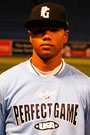 Jacob May – OF
Jacob
May, the grandson of former big league slugger Lee May, attended the
2009 PG National Showcase as a 5-foot-10, 175-pound switch-hitting
shortstop. He earned a PG grade of 10 at the event, showing good foot
speed by running the 60-yard dash in 6.69 seconds while throwing 85
from across the infield. His performance garnered this report:
Small
but very athletic build, good present strength. Very good defensive
actions, range to both sides, excellent body control, plus hands, 2B
star potential at pro level, SS/2B at college level. Switch-hitter,
similar approaches, better bat speed from left side, contact/high
average approach, handles barrell well, will hit to all fields, line
drive plane, hits with hands, 6.69 runner with quick first step.
Could create some good draft interest, but maybe a lot more after
college. He can really play!
That
report proved to be a good prognostication for May's future career
path, as he ended up attending Coastal Carolina after the Reds took
him in the 39th round of the 2010 draft out of high
school.
Player's
of May's size often have to prove themselves at every step along the
way to get drafted where their talent, not their stature, may
warrant. Although he hit only .206 his freshman year in college he
rebounded well the summer that followed in the Northwoods League,
hitting .296 with 14 extra-base hits while proving to be a nuisance
on the basepaths. That success carried over to his sophomore year
when he hit .306 with 27 stolen bases; the summer of 2012 on the
Cape, being named the 25th best prospect on the circuit;
and finally his junior year at Coastal Carolina, hitting .324 while
collecting 21 extra-base hits and 16 swipes.
Since
he didn't possess the ideal arm strength for shortstop, it was
determined that his speed and overall profile would fit best in the
outfield as a prototypical top-of-the-order threat. Here is May's
pre-draft report from 2013, when he was named the 183rd overall draft-eligible prospect:
Not
only is May one of the fastest, most-athletic players in the 2013
college class, but he looks as graceful as a deer running across a
pasture at full gait … Initially pegged as high as a possible
second-rounder, May now appears a better fit in rounds 4-6. The
biggest area of concern to scouts remains his bat. A switch-hitter,
May has a simple, contact-oriented approach at the plate, geared
towards staying inside the ball and filling the gaps with line drives
… That said, May’s game is predicated by his speed, as he has led
Coastal in stolen bases the last two years.
His
overall profile was similar to that of Phil Ervin, who May played
with during the summer of 2011 in the Northwoods League. Ervin,
considered the better, more consistent offensive threat, ended up
being a first round pick of the Reds in 2013. The White Sox, who
always place a premium on dynamic, well-rounded athletes, plucked up
May in the third round the same year. – Patrick Ebert
Cleveland Indians
 Clint Frazier – OF
Frazier's
ascension to the top high school position player selected in the 2013
draft came largely in two steps, with a mythical day attached prior
to the draft.
Frazier
was basically an unknown on the national stage when he came to the
2011 PG Junior National Showcase in Fort Myers, Fla. as a third
baseman. He ran a 6.9 60-yard dash, threw 89 mph across the infield
and was probably the best hitter at the entire event during the
games, although his funky hand hitch swing did already raise some
concern. It was immediately obvious that not only did he have high
level tools, he also played the game with a passion and could perform
up to those tools.
During
the spring of his junior year, one started to hear rumblings about
the kid in Georgia who was putting up video game numbers. That would
have been Frazier, who hit 24 home runs that spring. So when Frazier
showed up at the 2012 PG National Showcase in Minnesota, he was no
longer a low profile player.
He
put on a show at the Metrodome that ranks with the best ever seen at
a PG National. Frazier ran a 6.42 60-yard dash. Now an outfielder, he
threw 98 mph during drills despite having a tender arm. He hit
absolute bombs in batting practice, including one absurd one when he
reached for an outside pitch and visibly only had one hand on the bat
when he hooked it down the left field line. He played the game like
his mane of red hair was on fire. PG's Todd Gold commented in his
scout notes that "He plays like he's in fast forward."
Despite
being a 6-foot righthanded hitting outfielder with flawed hitting
mechanics, it was easy to rank him as the top prospect in the
country, although there was plenty of discussion and some anxiety
about it. The tools, the personality and the performance were just
too loud.
Frazier
went out the next spring and sealed the deal with a single
performance. His March 12 matchup against fellow top prospect and
2012 PG All-American Austin Meadows was the most talked about and
scouted game of the spring. Frazier hit two home runs, including an
epic blast that was one of the longest observers had ever seen (watch here).
He
went on to hit .485-17-45 his senior year and added 22 stolen bases.
The Indians picked him with the fifth overall pick, giving a $3.5
million signing bonus. – David Rawnsley
Tyler Naquin – OF
A
talented two-way prospect in high school, Naquin's arm strength was
evident early in his career. Playing for the Houston Heat travel ball
club at the 2008 WWBA World Championship in Jupiter, Fla., Naquin
dialed his fastball up to 92 mph from a low effort delivery the
mound, working consistently in the 88-91 range while consistently
making hard line drive contact. A high energy player, Naquin got down
the first base line quickly, busting out of the box at contact, and
was aggressive on the basepaths even though he wasn't a pure burner.
A
6-foot-1, 160-pound athlete, Naquin's athletic talents were evident,
but it was clear at the time that three years in college could go a
long way for his prospective draft talent as he added strength and
honed his lefthanded swing, especially after he was drafted by the
Orioles in the 33rd round of the 2009 draft.
That
occurred at Texas A&M, although not initially, hitting .244 as a
freshman prior to his breakout sophomore campaign when he led the Big
12 with a .381 average and the entire nation in hits with 104. His
numbers were nearly identical his junior year.
His
overall profile was that as an outfield 'tweener. While he showed
very good plate discipline and pitch recognition skills, he never
displayed the raw power potential to be an everyday fixture on an
outfield corner. And while he displayed good speed and instincts,
center field wasn't a perfect fit either. For as good as he was as a
hitter, his aforementioned arm strength remained his best pure tool, routinely
showing off accurate, cannon-like throws from right field playing for
the Aggies.
However,
Naquin may have been ranked even higher than his PG pre-draft rank as
the 20th overall prospect had he been the regular center
fielder for Texas A&M. He played right field in college due to
the presence of teammate Krey Bratsen, a more dynamic athlete who
possessed true game-changing speed. Either way, Naquin's draft ranking was
a good estimation for his eventual selection, as the Indians took him
with the 15th overall pick in the 2013 draft when he was considered one of the
safest bets to succeed at the professional level. – Patrick Ebert
 Mitch Brown – RHP
Brown
was a four-year veteran of Perfect Game events, pitching at 19
different tournaments and showcases starting with the 2009 WWBA
National invitational. His notes from that event, where he topped out
at 78 mph, read:
Slender,
athletic body, very young, smooth delivery, longer 2-piece arm
action, sharp 11/5 CB, lands closed, across body, good shape on CB,
can pitch a bit, has idea, body and arm project, throws easy, High
3/4's.
Brown
filled out to a strong 6-foot-2, 210-pounds over the next four years
and saw his fastball grow into a 90-plus mph pitch but much of the
rest of that initial scouting blue print remained the same. He always
had a long and fast arm action, he always had an advanced idea how to
pitch despite his Minnesota roots and he could always spin the ball.
The
curveball was his out-pitch early in his high school career but he
kept adding to his breaking ball arsenal as he got older. Brown added
a slider first, then eventually figured out how to throw a cutter off
his fastball. He pitched at the 2012 PG Pitcher/Catcher Indoor
Showcase prior to his senior high school season, and while he showed
some understandable young confusion about his multiple breaking
balls, there was no mistaking the quality. Brown's notes from that
event, where he was 90-93 mph on his fastball, read:
Mature
well proportioned build, good strength. On line hand drop delivery,
fairly fast pace, quick easy arm, CB has hard tight spin, good life
on Chg, very straight FB, will come inside with FB, H 3/4's, throws
downhill, more effort on CB than FB, good change mechanics/arm speed,
tends to bury CB, works quickly, everything down in zone. Needs to ID
breaking balls, threw 76 downer and 84 SL during warmups, 79 slurve
and 88 cutter in games. Like the 76/84/88 progression and not the 79.
Brown
was even better during the spring than he was on that cold, indoor
February weekend. He was in the mid-90s right out of the gate and
showed all the national level scouts flocking to Minnesota the
quality and variety of his breaking stuff.
One
other aspect of Brown's overall resume endeared him especially to the
area scouts. Home visits are often one of the banes of the area
scout's existence. The Brown Family, although both parents are
professionals and not farmers, live at the end of a series of dirt
roads well outside of Rochester. Multiple area scouts told the story
of visiting the Brown's something like this: "That house is
pretty much impossible to find; I think I drove past that last dirt
road twice before finally convincing myself to try it. But once I got
there, that might have been the nicest family I've ever visited." – David Rawnsley
Detroit Tigers
 Buck Farmer – RHP
If
it seemed to serious prospect fans as if George Runie "Buck"
Farmer had been around seemingly forever when he made his MLB debut
last summer a scant 14 months after being signed out of Georgia Tech,
there is good reason for it. He pretty much has.
Farmer
made his debut with Perfect Game as a 15-year old rising sophomore at
the 2006 17u WWBA National Championship playing for the Ocee Stars.
He was 6-foot-3, 190-pounds at that point and throwing in the mid-80s
off the mound while gaining as much attention for his powerful
lefthanded bat. Farmer went on to become one of the better two-way
performers in the high school and travel ball circuits, including
winning the MVP award for the East Cobb Yankees after they won the
2008 Connie Mack national championship. The hometown Braves picked
him in the 46th round of the 2009 draft despite his commitment to
Georgia Tech.
Farmer
was a major contributor for four seasons at Georgia Tech, pitching
out of the bullpen primarily as a freshman and as a weekend starter
for his final three seasons. He went 8-4 with a 3.54 ERA and 115
strikeouts in 106 innings as a junior and was considered a potential
high round draft pick. However, Farmer slid in that 2012 draft as
clubs believed he wanted to return to Georgia Tech for his senior
year, finally being picked by the Brewers with a 15th round pick. He
did return as a senior to post a 9-5, 2.78 record with 122 strikeouts
in 113 innings.
Farmer's
scouting reputation throughout his college career was much the same
as it was when he was in high school. His fastball worked in the
low-90s and would flash plus occasionally, as would his slider and
changeup. But he consistently didn't show a plus pitch and depended
as much on his durability (he's never had an injury concern or likely
even missed a start) and his ability to pitch as his raw stuff. In
scout's eyes, Farmer was, and always had been, the consummate low
risk back-of-the-rotation starter.
And
that is what he is today, many years later. – David Rawnsley
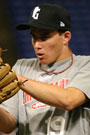 Kevin Ziomek – LHP
Vanderbilt
recruits the Northeast as well as any other college, as lefthanded
pitcher Kevin Ziomek was a well-known talent coming out of high
school. The Amherst, Mass. native was taken in the 2010 draft by the
Diamondbacks in the 13th round, but as the 46th best overall high school prospect in his class, he would have gone
much higher if it weren't for his commitment to play for the
Commodores.
Prior
to attending college Ziomek worked comfortably in the upper-80s and
frequently peaked at 91 mph while mixing in three quality off-speed
pitches, with his power slider and advanced changeup standing out. He
garnered a perfect PG grade of 10 at the 2009 National Showcase, and
at 6-foot-2, 180-pounds, he offered a lean, projectable build with
obvious potential gains in fastball velocity thanks to a fast, loose
arm and fluid delivery.
Not
surprisingly, Ziomek enjoyed immediate success during his freshman
year at Vanderbilt as he was eased into SEC competition in a set-up
role out of the bullpen. However, he didn't enjoy the same success
the summer that followed, and the same was true during his sophomore
year. Ziomek robounded well during his second stint on the Cape in
2012, leading to his breakout junior campaign.
Here's
a part of Ziomek's pre-draft report in the spring of 2013 when he was
ranked the 48th overall prospect:
(Ziomek)
was as dominant in his short stint as any pitcher on the Cape with
the possible exception of Hyannis left-hander Sean Manaea, a top
prospect for this year’s draft, with his solid-average major league
fastball, tight, downer breaking ball and changeup all working in
unison, all thrown with the same arm action. His changeup, in
particular, was outstanding and made his 91-93 mph fastball look even
faster, and also enabled him to freeze hitters with his breaking
ball. For the second straight year, Ziomek’s performance in
summer-league competition—good or bad—has largely carried over to
the following spring, and he has gone a sparkling 9-2, 2.03 through
his first 12 starts as Vanderbilt’s Friday starter. In 89 innings,
he has allowed just 53 hits, walked 29 and struck out 88—a
significant upgrade from 2012. With a couple of minor exceptions when
his velocity dipped, Ziomek has pitched every bit as impressively as
a junior for the Commodores as he did in his five-game cameo on the
Cape, with stuff and command to match. In the end, Ziomek has done
pretty much everything this spring that he was supposed to do from
the beginning of his career at Vanderbilt.
Ziomek's
expected yet modest uptick in velocity, as well as possessing one of
the best changeups in the 2013 draft, led to him being selected by
the Tigers in the second round with the 58th overall pick, which
reflects his pre-draft ranking that year. – Patrick Ebert
 Joe Jimenez – RHP
The
thing that stands out immediately when you look at Jimenez and his
Top 10 prospect status with the Tigers is that he was signed as an
undrafted free agent by the Tigers during the summer of 2013. One's
reaction, without knowing the player's background, would be "Wow,
the Tigers did a great job of scouting there; they must have seen
something that no one else did."
The
Tigers did obviously do a good job but it wasn't because Jimenez
wasn't a well known prospect. At draft time Jimenez was the second
ranked prospect from Puerto Rico on the Perfect Game class of 2013
rankings behind PG All-American Jan Hernandez and was the 95th ranked
overall prospect in the entire class.
Multiple
scouting industry contacts at the time and media reports afterwards
said that Jimenez, who was a very good student at Puerto Rico
Baseball Academy and High School and had signed with Florida
International, floated a large number as the bonus he needed to sign
and didn't waver from that number through the draft. No team even
ventured a mid-round or late-round pick on him, which in retrospect
seems like 30 teams worth of mistakes, so he went completely
undrafted and was thus a free agent when the draft ended.
Jimenez
had made his big debut about 18 months prior to the draft when he
pitched at the 2011 WWBA World Championship in Jupiter, Fla., for a
Perfect Game team. He pitched in the 90-92 range at that heavily
scouted event, although his big and strong body had some softness to
it.
Over
those 18 months, Jimenez did two things that made his prospect stock
continue to rise. First, he worked on his conditioning and gradually
turned some of that softness into mature muscle while maintaining the
looseness and speed in his arm. Secondly, he developed a slider that
was a legitimate second pitch to go with his steady low-90s fastball.
Jimenez had started out throwing a soft low-70s curveball that was
strictly a get-me-over pitch that he commanded well but that would be
an easy target for barrels at the professional level.
Based
on his build, his delivery while an amateur and his pitches –
Jimenez also threw a very serviceable changeup prior to signing –
it seemed as if he would have a future as a starter. He's obviously
blossomed thus far as a reliever, but maybe the key part of the
entire process was just the local Tigers scout sticking with the
undrafted free agent and getting the deal done. – David Rawnsley
Kansas City Royals
Hunter Dozier – 3B
Like
his fellow Royals' top prospects and first-round picks Kyle Zimmer
and Sean Manaea, Dozier was an unheralded prospect out of high school
who fell under the scouting radar and went to a less than prominent
baseball school.
In
Dozier's case, he attended Denton High School on the north side of
the Dallas-Fort Worth Metroplex, where he was a three-year starter in
baseball along with quarterbacking the Denton football team. He gave
up football after breaking his collarbone his junior year in order to
concentrate on baseball. Dozier stood out as both a lanky middle
infielder and as a righthanded pitcher on the baseball field. He only
appeared in a couple of Perfect Game tournaments for the Dallas
Tigers after his sophomore year and was listed at a slender 6-foot-3,
160-pounds. Dozier was listed at 6-foot-3, 195-pounds when he arrived
at the Stephen F. Austin campus northeast of Houston for his freshman
year.
Dozier
was a starter at shortstop for Stephen F. Austin from the beginning
of his freshman year in 2011 and immediately stood out for his
athleticism in the middle infield and for his righthanded power
potential. Stephen F. Austin is usually not a homing beacon for
scouts and cross-checkers, but they received plenty of attention in
2011 due to his teammate, outfielder Bryson Myles. Myles was
eventually picked by the Indians in the sixth round. That helped put
Dozier on the scouting map.
By
Dozier's junior year he had grown to 6-foot-4, 220-pounds. Although
he still moved well at shortstop, scouts had already consigned him to
third base at the professional level. What created the most interest
was Dozier's power, as he hit .396-17-52 as a junior.
Most
scouts and analysts believed Dozier to be a late first round to early
second round pick leading up to the 2013 draft. The Royals, holding
the eighth and 34th picks, didn't want to risk trying to let Dozier
slide to their second pick. So they created and executed a plan to
pick Dozier in the eighth slot while grabbing Manaea, a potential
first overall pick prior to his injury-plagued junior season, with
the 34th pick. Dozier signed almost immediately for a $2.2 million
signing bonus, saving the Royals $937,800 on the assigned slot value
that they then used to help sign Manaea. – David Rawnsley
Kyle Zimmer – RHP
Scouts
often refer to a young pitcher who hasn't thrown much as having a
fresh or low-mileage arm. It's almost always used as a positive term,
translating to "he hasn't been abused or taught bad things yet."
It
can also be a double-edged sword on occasion, as the Royals are
finding out while trying to get Zimmer healthy enough to use his
prodigious talent on the mound. And you won't find a top prospect
pitcher with much lower mileage on his arm than Zimmer.
Zimmer's
high school baseball resume at the end of his junior season at La
Jolla High School consisted of one year of varsity play as a reserve
position player, where he hit .191-1-2 in 47 at-bats, with no
appearances on the mound He blossomed as a third baseman as a senior,
hitting .375-4-23 and being recruited by the University of San
Francisco as a position player. Zimmer did pitch some as a senior,
going 3-3, 4.69 and allowing 38 baserunnners in 22 innings.
Zimmer
didn't get into a game as a freshman position player at USF his
freshman year but he did make five short relief appearances on the
mound totaling 5 1/3 innings (0-0, 8.44). He didn't become a
full-time pitcher until his sophomore year, going 6-4, 3.73 in 91
innings for the Dons and helping them to an NCAA Regional berth.
Still, Zimmer was a virtual unknown to scouts until he took the mound
against UCLA's Gerrit Cole, the then presumped first overall pick in
the 2011 draft, in the first Regional game. With a capacity crowd
watching, including plenty of scouts, Zimmer threw a complete game
shutout to out-duel Cole, striking out 11 Bruins with the combination
of a 92-94 mph fastball and a plus curveball. He went from an unknown
to a potential first round pick in nine innings.
That
kind of stuff and the command that Zimmer surprisingly had despite
his lack of experience continued through the summer in the Cape Cod
League and through his junior year, where he went 5-3, 2.85 in 13
starts and 88 innings, striking out 107 hitters while only walking
17. He did miss a couple of late season starts with a hamstring
injury which complicated his draft status a bit, as teams couldn't
get that valuable final look at him before the draft.
The
Royals jumped on Zimmer right away, grabbing him with the fifth
overall pick and signed him quickly with a $3 million signing bonus. – David Rawnsley