Following Baseball Prospectus' top prospect lists, the 'Before They Were Pros' series provides reports on the top prospects in baseball from their time in high school at PG events.
As part of Perfect Game's partnership with Baseball Prospectus, David Rawnsley, Todd Gold and Patrick Ebert will be conducting a “Before They Were Pros” series, providing scouting reports on some of the top prospects in baseball from when they were in high school attending PG events. This six-part series (one for each division in MLB) will appear once Baseball Prospectus has provided their own detailed scouting reports of the top prospects, team-by-team, as part of their own series.
We continue with a look at the National League Central. Be sure to read Baseball Prospectus' features on each of the five teams:
Cubs | Brewers | Pirates | Reds | Cardinals
And here are links to last year's series where more reports can be found:
NL East | NL Central | NL West | AL East | AL Central | AL West
Chicago Cubs
 Kris Bryant – 3B
Baseball's
top power hitting prospect, along with fellow Las Vegas native and former PG All-American, Joey
Gallo, Bryant was a much scouted and debated player in high school
without there being a consensus about any of his future tools or even
his future role.
One
thing that Bryant could do back at Bonanza High School was, not
surprisingly, hit for power. He started his swing from a fairly high
hand position for a long, power oriented swing and generated
tremendous back spin on the ball from his swing plane. My notes from
the 2009 Perfect Game National Showcase evoked a comparison to Dave
Kingman – who arguably hit the highest pop up/fly balls in the
game's history – for how high Bryant's balls went in the air and
how long they stayed. There are no 7.0 plus second hang times
recorded in the PG database, but they surely existed and were
probably frequently repeated. It was a fairly calm and low effort
swing for such huge power and it stood out more for it's leverage
than for its raw bat speed.
The
rest of Bryant's tools, and his future position, along with his
ability to make enough square contact to use his prodigious power,
were the subject of debate. He had balanced actions at third base and
even played some shortstop at times, but was a 7.0 runner in the
60-yard dash and had only average arm strength across the diamond.
There was plenty of talk about first base and left field.
High
school pitching wasn't much of a challenge for Bryant and he hit
.489-22-51 as a high school senior, although scouts were still only
lukewarm in their evaluations, similar to what Gallo was to go
through two years later with similar performance numbers. Bryant was
considered a very difficult sign with a strong desire to go to
college at San Diego and it was a surprise to no one when he was only
picked in the 18th round by the Blue Jays as a speculation pick.
While
Bryant's first two collegiate seasons were very strong (.365-9-36 as
a freshman, .366-14-57 as a sophomore), they merely set the stage for
his junior year. At a time in college baseball when players just
weren't hitting home runs and entire teams barely broke double
figures in long balls, Bryant hit 31 home runs all by himself despite
getting walked 66 times in 57 games. In addition, Bryant had matured
athletically as a defensive player at third base and much of the
doubt about his future at third base had been quieted.
Bryant,
along with college righthanders Mark Appel and Jonathan Gray, were
generally considered the top three prospects in the 2013 draft. When
the Astros went with Appel with the first pick, the Cubs chose Bryant
and signed him to a $6.7 million signing bonus. – David Rawnsley
 Billy McKinney – OF
The
most important tool for a position player is the hit tool. It is also
the most difficult to accurately grade, and it also just so happened
to be Billy McKinney's carrying tool.
The
Plano (Texas) High School product and 2012 PG All-American topped out
at average or slightly below in every other tool category. That
typically precludes a high school prospect from first round draft
consideration. In the case of McKinney however, it led to a wide
range of opinions amongst scouts. He was seen as a major wild card,
with some scouts extolling his bat to ball virtues, and others
suggesting he was a streaky hitter with a moderate power ceiling.
David
Rawnsley broke down McKinney's offensive profile in his pre-Draft
Focus profile by saying the following:
He
has very sound hitting mechanics, with a lefthanded swing that is
very quick and compact to the ball with outstanding raw bat speed. He
is especially aggressive on the inside half of the plate and can pull
the highest velocity fastballs with authority. McKinney also has some
lift in his swing plane and the ability to put back spin on balls and
hit them deep to the gaps. The teams that are most interested in
McKinney are going to likely grade him out at least as a 60 (MLB
plus) in both the hitting and power categories.
While
there was some question as to whether McKinney would be picked in the
first round, there was rampant speculation as to which team would be
the one to pull the trigger if given the opportunity. Organizations
show tendencies as to which types of profiles they prefer and which
tools they place highest priority upon. There were a small handful of
organizations that seemed to fit the bill as potential suitors for
McKinney who held picks in the late first round. Oakland likely
realized this and knew that he wouldn't be on the board when their
second pick came around, even though he didn't look like a
traditional first round high school prospect.
Given
his advanced hit tool it shouldn't come as a huge surprise in
hindsight that McKinney was able to skip low-A entirely and not miss
a beat. The question about his ceiling remains, as a corner
outfielder with average present power production. But in terms of
contributing on both sides of the ball McKinney has hit the ground
running as a professional and is justifying his draft position. – Todd Gold
Milwaukee Brewers
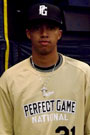 Devin Williams – RHP
Live-armed
righthander Devin Williams provided an interesting case study of a
pitcher who, step-by-step, gradually improved as the 2013 MLB Draft
approached, something David Rawnsley explained in great detail in
Williams' Draft Focus feature from April of 2013.
Playing
for the St. Louis Pirates travel ball organization, Williams
performed at a high level at numerous high-profile tournament events
across the country, beginning the summer after his sophomore year in
high school. He first took the mound as a 6-foot-3, 165-pound
righthander at the 17u WWBA National Championship where he peaked at
87 mph and threw four different pitches for strikes.
His
stuff, and overall status, took a significant step up the following
February at the 2012 Pitcher/Catcher Indoor Showcase, entering the
event as the 306th high school prospect in the 2013 class,
a ranking that shot up after throwing his fastball in the 88-90 mph
range while peaking at 91.
That
showing led to an invite to the 2012 National Showcase, where he
flashed similar stuff, although didn't take another step forward as
hoped. That happened four months later in Jupiter, Fla. at the WWBA
World Championship where Williams' fastball was much firmer, up to 93
mph, with improved bite on his slider, now his go-to breaking pitch,
and more polish to his changeup.
Williams
once again took the mound at the Pitcher/Catcher Indoor Showcase in
2013, and amidst a group of several high-profile arms that included
fellow St. Louis Pirates hurler Jake Brentz and PG All-American
Clinton Hollon, Williams may have had the best performance. Throwing
loose and easy, with an athletic, repeatable delivery, his fastball
now peaked at 94, and his changeup, thrown with the exact same arm
speed and overall action as his fastball, continued to be a very good
secondary pitch for him.
Later
that spring Williams, who grew to 6-foot-4, 190-pounds, appeared to
have finally tabled his curveball for his slider, a pitch he seemed
hesitant to throw, but when he did showed very good potential. A
hard-biting breaking pitch, he could throw his slider as hard as 85
mph, and also learned to take a little off of his fastball, now up to
95, for two-seam life in the upper-80s to low-90s, to go along with
his usual low-80s change.
All
of this led to Williams being ranked PG's 14th best high
school prospect and 29th overall draft prospect prior to
the 2013 draft, which put his name in the conversation for the first
round. Although there were some indications that he could go as high
as the middle of the first round, he slipped to the middle of the
second, where the Brewers, who had lost their first round pick after
signing Kyle Lohse as a free agent the previous offseason, were
thrilled to pick him up. – Patrick Ebert
 Jorge Lopez – RHP
A
lean, projectable and well-coordinated 6-foot-4, 175-pound athlete in
high school in Puerto Rico, Lopez was a gifted all-around athlete
that excelled in numerous sports, including basketball, track and
field and volleyball. His volleyball talents in particular could have
led to a promising collegiate career, but it was his progression as a
pitcher as a converted shortstop that pointed to the best route for a
professional career.
Lopez
attended numerous PG tournament events stateside to make him a well
enough known commodity, seeing a steady progression to his fastball
velocity from the mid-80s in 2009 to his peak velocity of 91 at the
WWBA World Championship in Jupiter, Fla. in late October of 2010.
However, it was his appearance at the 2011 World Showcase in early
January that may have ultimately led to him becoming such an early
round draft pick (second round) later that year.
Here
is his report from that event:
Slender
young build, should gain strength but not much weight. Slow paced low
effort delivery, high 3/4's release point, pulls off some on release,
very long and loose arm, good use of his lower half. Fastball to 91
mph, velo comes easy. Flashes hard curveball spin when on top of the
ball, changeup shows nice sink and should be thrown more. Very nice
young pitching prospect who should keep improving.
That
performance also led to Lopez being ranked the 83rd prospect in the high school class of 2011. With an upper-80s to
low-90s fastball, a promising overall three-pitch mix, and a lean,
projectable frame Lopez gave Puerto Rico, usually known more for
producing toolsy middle infielders and strong-armed catchers, a rare
top-flight pitching prospect that appeared to only be scratching the
surface of his potential. Because of that Lopez garnered pre-draft
comparisons to 14-year MLB veteran Javier Vazquez, who coincidentally
played his last year in the big leagues the same year Lopez was
drafted. – Patrick Ebert
Tyler Wagner – RHP
Although
Wagner had no shortage of opportunities to be seen playing for
national powerhouse Bishop Gorman High School outside of Las Vegas,
it wasn't until he made a permanent transition to the mound that he
started to get noticed by scouts and recruiters. He also made the
most of his appearance at the 2008 West Uncommitted Showcase, where
he threw in the 86-89 range with a mid-70s curveball, which helped
lead to his commitment to play for Utah. Here's the PG scouting
report from that event:
Tall
athletic build, body projects well on the mound, long arm action,
quick and easy, balls come out of his hand well, good feel for
curveball, 11-to-5 curveball with tight break, stays tall, new to
pitching, very good projection, strong student, plays for a very
strong high school team.
As
expected his velocity continue to improve pitching for the Utes,
being used exclusively in short relief. He made only 10 appearances
as a freshman, recording three saves and a 2.11 ERA prior to his
breakout sophomore season in which he saved 12 games with a 2.04 ERA
in 35 1/3 innings of work.
By
his junior year Wagner was peaking in the mid-90s with a relatively
fresh and still improving arm, although he didn't perform as well as
he did during his sophomore year. Leading up to the 2012 draft he was
ranked the 121st overall draft prospect with many
wondering how well he would fare in a starting role at the next
level, and garnered this report:
The
rangy 6-foot-3, 195-pound Wagner has an explosive arm with a fastball
that frequently touches 95 mph and gets on hitters quickly from a
three-quarters slot. He also has a second plus pitch in a power
slider, giving him two weapons needed to excel as a closer. Wagner
had only two saves in 17 appearances in early May, though as his
opportunity to close out games was limited. At the same time, Wagner
struggles to throw strikes consistently, which led to a 2-5, 3.98
record, while walking 21 and striking out 29 in 32 innings. Had he
pitched more like he did in 2011, Wagner might have been a fit as
early as the third round, though is still expected to be the state’s
top pick.
Wagner
was drafted almost exactly where he was ranked, going in the fourth
round – 155th overall – to the Brewers in the 2012 MLB
Draft. – Patrick Ebert
Pittsburgh Pirates
 Reese McGuire – C
McGuire
first appeared at a Perfect Game event in August, 2011, following his
sophomore year, traveling down to San Diego from his Washington home
to play in the PG National Games following the Perfect Game
All-American Classic. It was love at first site for this scout, as
McGuire almost immediately pegged himself as a potential first round
candidate for 2013. Here are my notes from those first two days at
the USD field:
Low
and flexible set up, + hands, + arm, easy actions, stud, hosed guy
from knees on perfect release/throw, one of the best game blockers
I've seen in ages, plays C like a shortstop. Solid build, square
strong shoulders, thin waist, loose quick swing, lifts and shows
power, good bat speed, aggressive swing, solid pull contact, HRs,
tries to hit it hard, 4.38 Like!
That
may be the only time that I've ever written "plays catcher like
a shortstop" in my notes and it was a reoccurring theme with
McGuire over the next two years. There was one sequence at the 2012
Tournament of Stars when McGuire was catching lefthander Stephen
Gonzalves – who was a fourth-round pick of the Twins – in a late
inning, bases loaded jam. The six-pitch sequence to the hitter was
perfectly symmetrical: First pitch 59-foot curveball that McGuire
blocks, second pitch 91 mph fastball for a strike, third pitch
59-foot curveball blocked again, fourth pitch 91 mph fastball for s
strike, fifth pitch, etc. McGuire's ability to completely deaden
pitches in the dirt, especially breaking balls, completely separated
him from his peers behind the plate. He had an extremely rare
combination of anticipation, cat-like quickness and polished high
level technique to his blocking.
Of
course, it didn't hurt his overall defensive profile that McGuire
also had a plus arm and was regularly in the 1.90's during games on
his pop times and in the low 1.80's during drills.
McGuire
went on to star for the gold medal winning USA 18U National team,
leading them in batting average (.400), runs scored (11) and walks
(nine versus only three strikeouts) in 13 games while splitting the
catching duties with fellow Perfect Game All-American Chris Okey.
That
combination of defensive and offensive ability enabled McGuire to go
14th overall in the 2013 draft, the second highest a high school
catcher has been selected behind Kyle Skipworth (sixth overall pick,
2008/Marlins) in the last 10 years. The Pirates signed him out of a
University San Diego commitment almost immediately after the draft,
giving him a $2,369,000 bonus. – David Rawnsley
 Austin Meadows – OF
2012
PG All-American outfielder Austin Meadows fit comfortably into two
appealing draft demographics coming out of high school; the
“performer," and the "jeans salesman."
The
former is self explanatory, as Meadows performed at a high level
throughout his prep career. He burst onto the national scene by
hitting .571 for Team USA's 16u National team in 2011. He put up big
numbers in high school ball and made a lot of contact against quality
pitching on the national showcase circuit. While scouts give very
little weight to high school stats, performance track record is often
a tiebreaker between two similarly talented prospects.
The
latter is a term borrowed from Michael Lewis' bestseller Moneyball.
Within the book, Oakland A's GM Billy Beane is quoted as telling his
scouts in the draft room that "we're not selling jeans here"
in regards to the importance placed on player body types. As a high
school prospect, Meadows had the "prospect body," with a
long, high-waisted 6-foot-3 frame and strong lean 200-pound build
with room to carry additional muscle mass.
The
equation created by being a strong present contact hitter who would
likely offer at least solid contributions in the average department,
combined with his above average speed and strength projection, hinted
at the potential to be an impact player. His arm strength was the
only tool that scouts were confident didn't have plus potential,
giving them the opportunity to dream on a four-plus tool player. The
fact that he didn't show present power and had a swing that would
require adjustments to tap into his raw power potential created some
risk, but his solid floor was seen as relatively stable. Prospects
who offer relative certainty tend to go high in the draft, but those
whose security come with upside are the type that come off the board
in the top half of the first round.
There
was also some question as to his future defensive home. The straight
line speed he showed in the 60-yard dash suggested he had the
potential to be an above average defender in center field. Though he
didn't take that same speed into the outfield at the time, leading
many to project him to wind up in left field long term. Had his speed
translated from the 60-yard dash and his raw power translated from
batting practice Meadows might have been one of the first players
selected in the 2013 draft. He didn't last very long regardless,
going ninth overall. – Todd Gold
Cincinnati Reds
 Michael Lorenzen – RHP
Big
tools have always defined Lorenzen's game, with one of, if not the
best combination of speed and arm strength of those eligible for the
2010 draft. His speed is shown by the 6.54 60-yard dash time he
recorded at the 2009 West Coast Top Prospect Showcase, and his arm
strength by the 99 mph throw he made from the outfield at the 2009
National Showcase, one of the best such throws at any Perfect Game
event.
Here
is the report he received from the National:
Lean
athletic build with sloped shoulders, loose actions. Two-way prospect
because of special arm. Huge OF arm strength, 99 mph in drills, 6.80
speed. Balanced hitting approach, good clean swing, creates bat
speed, gap to gap power, can handle the bat head, projects much more
strength. Arm strength translates to mound, FB easy 91-93 mph, simple
delivery with long arm stroke, low effort release, SL has good depth,
CB spins hard, may have higher ceiling as RHP. Could explode by next
June as a pitcher. Early draft possibilities especially on the mound.
Lorenzen's
performance led to him being selected to play in the PG All-American
Classic that same summer, and despite being drafted by the Rays the
following June in the seventh round as the 54th best high
school prospect in the 2010 class, he decided to forego his pro
career at the time and honor his commitment to Cal State Fullerton.
His
career with the Titans, which initially began as a primary
outfielder, got off to a good start, as he hit .342 with a .427
on-base percentage and was 19-for-26 in stolen base attempts. He
didn't take the mound during his freshman year, but that changed
during his sophomore season, recording 16 saves in a two-way role. He
never hit as well as he did during his freshman season, hitting .297
as a sophomore and .335 as a junior, but he added 19 more saves
during his final season at Cal State Fullerton giving him 35 in two
years while setting the school's all-time record.
Offensively
his profile was similar to that of another former college standout,
Drew Stubbs – who was also a first round pick of the Reds – with
good speed, great range and instincts in center field, his strong arm
and intriguing power potential, especially to the right-center field
gap as a righthanded hitter. However, the more time Lorenzen got on
the mound the more it became impossible to ignore his special arm
strength, as noted in the showcase report shared above, peaking as
high as 99 mph during his junior year and routinely working in the
mid-90s in a short relief role to go along with a sharp breaking
ball.
Ultimately
the Reds selected Lorenzen in the supplemental first round of the
2013 draft. It was believed leading up to the draft, when he was
ranked by PG as the 44th best overall prospect, that he
may be allowed to begin his career as an outfielder, with pitching
being a very realistic fall-back option down the road. However, the
Reds selected him with the intent of him pitching at the professional
level from Day 1. – Patrick Ebert
 Ben Lively – RHP
At
6-foot-4, 180-pounds, Lively offered a lean, projectable frame with
obvious growth potential. He frequently peaked in the low-90s, as he
did at the 2009 WWBA World Championship, and was ranked the 235th high school prospect the class of 2010 prior to being drafted in the
26th round by the Indians that year. That wasn't early
enough to sign him away from UCF, although he didn't truly break out
until the summer of 2012 during his time spent on the Cape.
However,
during that time he was often overshadowed by being part of what has
to be looked back at as one of the great pitching staffs in the
history of the Cape Cod League. The Yarmouth-Dennis Red Sox staff
staff included Andrew Thurman, Chris Anderson, Alex Gonzalez, and
Aaron Blair – each of those pitchers were taken in the first 40
picks in the 2013 draft.
The
impressive aspect of Lively’s Cape emergence was how well he
carried his stuff deep into the summer. In fact, his stuff ticked up
somewhat by summer’s end. He mostly worked at 91-93 mph with his
sinking fastball, and he relied very heavily on this pitch. His 76-78
mph curveball flashed solid action, but was fringy over stretches of
the summer. His 81-84 mph changeup was a reliable offering, but if he
got into trouble it would still be his fastball that not only induce
weak contact, but allow him to miss bats as well. That ability to
stay off the barrel on the strength of his fastball was what opened
the eyes of many scouts during that summer.
The
numbers spiked for Lively in his final spring at UCF, as the 6-foot-4
righty finished his collegiate career with a flourish. He posted a
2.04 ERA, allowed just 88 hits in 106 innings, and struck out 101
batters along the way. The velocity was closer to 89-92 mph at times
during the spring, but he did top as high as 94 and consistently
showed that heavy fastball life that put him on the map the summer
prior. That led to the Reds taking
him in the fourth round of the 2013 draft. – Frankie Piliere
 Nick Travieso – RHP
A
native of Southeast Florida, Travieso put his name on prospect lists
at an early age as he was topping out at 92-93 mph the summer
following his freshman year in high school. However, the 6-foot-3,
200-pound righthander never saw his name near the top of the lists
and wasn't selected as a Perfect Game All-American.
The
reason was that Travieso rarely pitched until his senior year in high
school. He attended two powerhouse programs in American Heritage
(freshman/sophomore) and Archbishop McCarthy (junior/senior) and was
a middle-of-the-order power hitting corner infielder and occasional
relief pitcher in those deep and talented programs. In fact, Travieso
only threw 18 innings his junior year. It was much the same story for
the South Florida Elite Squad team he played for in the summer and
fall.
Travieso,
who was committed to Miami, began working as a starter as a senior
and regularly pitched in the 93-95 mph range while topping out at
98-99 mph on a consistent basis. There were even reports of him
touching the magical 100 mph mark on some radar guns. Even with that
type of velocity, Travieso wasn't getting across the board
recognition as a probable first round draft choice. While his lack of
innings on the mound and his overall athleticism gave him the fresh
arm and clean health resume that scout's value, he had also spent
very little time working on his secondary pitches. The PG database
shows numerous events when Travieso didn't throw a single breaking
ball and only a couple of rare changeups.
While
Travieso's slider showed improvement with use and repetition during
his senior year, it still was a hard pitch to project due to his
delivery and arm action. This breakdown of Travieso's mechanics
appeared on the PG website in his pre-draft report in May, 2012:
Travieso
has a well-paced delivery with a compact and short high arm circle in
back and gets very good use of his strong lower half to generate
power and torque prior to release. He also leans off pretty severely
on release and spins to the first base side. The result is when
Travieso releases the ball he’s coming inside and over it in a
pronounced way. That makes it very difficult for him (or any pitcher)
to get on top of and out front of a breaking ball and create
consistent quality spin on the ball and also presents somewhat of a
tip to advanced hitters because he has to change his hand angle and
position for a breaking ball.
His
breaking ball has gone between a upper-70s slurve type curveball to a
low- to mid-80s slider over the past year and reports out of Florida
this spring seem to indicate that he’s becoming more consistent
throwing a true slider with more consistency as he gets more
repetitions. He also throws a changeup that is in the developing
stages and pitchers with this type of arm action and mechanics have
frequently been able to develop power split-finger fastballs as they
mature.
The
Reds, who scout Florida as heavily as any organization in baseball,
knew all of this, of course. They also place a premium on high
ceiling young, fresh arms and had seen virtually every one of
Travieso's outings that spring. They surprised some of the industry
by grabbing Travieso with the 14th overall pick and proceeded to sign
him only a couple of days later for a $2 million signing bonus,
$375,000 under the MLB recommended bonus for that slot. – David Rawnsley
Phil Ervin – OF
A
gifted overall athlete and a three-sport star in high school, Ervin
was a part of state championship teams in both baseball and football
at Leroy High School in Alabama. Since he didn't focus on just one
sport prior to attending Samford, Ervin wasn't a well-known commodity
on the travel circuit prior to his collegiate career. In fact, the
only PG event he attended was in 2007 as a 14-year old at the 15u
WWBA National Championship.
That
changed quickly in college, hitting .371 during his freshman year on
his way to being named a Freshman All-American. The productivity
continued throughout his sophomore and junior years, as well as the
summers in between, as he was named the No. 22 prospect in the
Northwoods League in 2011 only to earn MVP honors on the Cape the
following summer.
Despite
being 5-foot-10, 205-pound coming out of college, Ervin showed true
five-tool ability. Although you wouldn't think he could generate
significant pop, his electric bat speed, among the best of those
eligible for the 2013 draft, made up significant ground on sluggers
with more prototypical statures. He also displayed good foot speed,
routinely showing advance instincts in the outfield, and his arm
strength allowed him to take the mound occasionally where he would
peak in the 92-93 mph range.
Here's
his PG draft report coming out of Samford, when he was ranked the
30th best overall prospect:
The
5-foot-10, 195-pound Ervin established himself as a first-rounder
last summer in his first 15 games in the Cape Cod League, when he
went deep eight times on his way to earning league MVP honors. He has
continued to sting the ball at a steady clip this spring for Samford,
hitting .364 with a team-high 10 homers, even as he has been pitched
around extensively … Though he isn’t overly physical in his sub
6-foot frame, Ervin generates excellent bat speed with his
lightning-quick hands and flashes raw power to all fields. More than
just a power threat, Ervin has a solid all-around approach to hitting
with good bat control and a patient approach, and stays inside the
ball well while emphasizing going the other way. His speed and
ability to run down balls in center field are also significant
assets, and he has been clocked up to 93 mph off the mound in
occasional stints as a pitcher.
A
three-year starter in center field for the Bulldogs, Ervin finished
his junior year hitting .337-11-40 with 21 stolen bases in 23
attempts and was selected by the Reds in the first round with the
27th overall selection in the 2013 draft. – Patrick Ebert
St. Louis Cardinals
 Rob Kaminsky – LHP
Polish
has always been a word scouts have heavily associated with Rob
Kaminsky and one that has been featured in his scouting reports
dating back to his early years in high school. It’s something he
ultimately acquired through years of pitching at the highest
tournament levels with the Tri-State Arsenal.
Despite
his less than prototypical pitcher’s frame, Kaminsky showed signs
of precocious velocity as far back as 2010, coming off what was only
his freshman year in high school. Pitching at the 15u WWBA National
Championship, the young Kaminsky showed an 84-90 mph fastball, and
perhaps more importantly already showed a tight and hard 75 mph
curveball, a pitch that has come to define his game.
However,
it was his absolutely dominant and eye-opening performance at the
2012 PG National Showcase that vaulted Kaminsky up the rankings,
which he continued to climb thanks to a strong senior year, finishing
his high school career as the No. 2 prospect in his class.
Here’s
his report from the PG National:
Steady
low-90s fastball, topped at 94 mph, mostly straight with occasional
small run. Nasty curveball with velocity, hard spin and depth, can
manipulate shape of CB and spot it to both sides of the plate,
plus/plus pitch, one of the best seen at this level. Rare changeup
but it was also plus with late diving action and good arm speed.
Absolutely no contest vs. hitters.
Kaminsky
went on to start the PG All-American Classic later that summer for
the East squad. In a number of ways, the scouting community went into
the spring of 2013 looking for ways to nitpick Kaminsky’s game.
There was a large degree of uncertainty at the top of the high school
pitching crop, and despite his often electric displays of stuff and
advanced command, it seemed that many remained skeptical of the hard
throwing lefty.
But,
to his credit, Kaminsky battled the often frigid Northern New Jersey
spring conditions and put together an outstanding and consistent
spring. And, on April 27 against rival Don Bosco, Kaminsky put
together an outing that may have cemented his status and erased many
remaining doubts scouts had voiced. Here is Perfect Game’s account
of that outing:
Rob
Kaminsky is continuing to make a strong case as the best prep
lefthander in the 2013 draft class. His velocity has jumped over his
last two outings, and he showed two clear plus pitches against Don
Bosco on Friday. Kaminsky pitched consistent at 91-94 mph over six
innings of work, and showed two variations of his plus breaking ball.
The harder version topped at 85 mph, while the more traditional
curveball we've seen from him in the past worked at 77-80. After
having some minor command problems early, Kaminsky was able to locate
his curveball with tremendous consistency throughout the game.
This
mid-spring performance was as good as we’ve seen Kaminsky in terms
of velocity and crispness to his breaking ball. But, his value still
lies in his ability to locate his elite level, plus curveball. It’s
always been the equalizer for him, and even in outings where his
velocity was closer to 88-91 as an amateur, he still left scouts
impressed with his ability to dominant on the strength of that true
hammer curveball. Some teams and scouts interpreted the use of his
curveball differently, referring to it as a crutch.
It
was that, and his less than prototypical 5-foot-11 frame that allowed
him to fall to the Cardinals at 28th overall. But, the teams that
looked past his frame saw the value in his plus makeup, ability to
repeat his delivery, and advanced feel for pitching at a very young
age. – Frankie Piliere
Charles Tilson – OF
Tilson
grew up on the north side of Chicago near Wrigley Field but was a
virtual unknown outside of Illinois before August 5, 2010. His New
Trier High School baseball team played together in the summer locally
and Tilson played football in the fall. He never played at a Perfect
Game event nor any other national level tournament or showcase prior
to the 2010 Area Code Games.
Dan
Durst, the White Sox scout (now with the Orioles) who organized the
Midwest Area Code Games team, told me just before the event started
"Wait until you see this center fielder I have, you're going to
love him. Nobody's ever seen him play outside of Illinois. He's even
committed to Illinois because none of the southern schools know who
he is."
Durst
was, of course, correct. The 6-foot, 165-pound lefthanded hitter was
the star of the week, using his blazing speed to wreck havoc on the
bases and track down everything in center field, then hitting the
only home run spacious Blair Field allowed that week as a bonus.
Scouts were left scrambling to figure out the new talent they had
shooting up towards the top of their lists.
My
notes from the event read as follows:
Outstanding
prospect, strong athletic build, medium frame, quick hands at the
plate, has deceiving pop, drives the ball, impact speed on bases,
3.18 steal, aggressive, 4.05, 6.54 in the sixty, drove 92 FB hard,
plays at 100% speed/effort, centerfielder with + range/quickness,
solid average arm. Potential 1st round type.
Tilson
went on to be the Illinois Gatorade Player of the Year as a senior,
when he hit .406 and stole 28 bases. The Cardinals drafted him in the
second round (79th overall pick) and signed him to a $1,275,000 bonus
right at the August 15th deadline. – David Rawnsley