AL West
| AL Central
| AL East
| NL West
| NL Central
As
part of Perfect Game's partnership with Baseball Prospectus, David
Rawnsley, Todd Gold and Patrick Ebert will be conducting a “Before
They Were Pros” series, providing scouting reports on some of the
top prospects in baseball from when they were in high school
attending PG events. This six-part series (one for each division in
MLB) will appear once Baseball Prospectus has provided their own
detailed scouting reports of the top prospects, team-by-team, as part
of their “Prospects Will Break Your Heart” series.
We
continue by looking at select top prospects from National League East
teams. Be sure to read Baseball Prospectus' features on each of these
five teams:
Marlins
| Phillies
| Mets
| Nationals
| Braves
Miami
Marlins
Andrew Heaney – LHP
Heaney
participated in four Perfect Game tournament events while in high
school, three of those with the powerful Texas Sun Devils program. A
6-foot-1, 150-pound athlete, Heaney worked in the mid- to upper-80s
back then with good feel for both a sharp overhand curveball as well
as a changeup. Although it wasn't expected that he would ever be a
flamethrower, it was evident that he had plenty of room to fill out,
and as a result it was expected that one day he would be throwing
consistently in the low-90s peaking several ticks higher.
Although
he was drafted in the 24th round in the 2009 draft by the Rays out of high school, Heaney
decided to honor his commitment to Oklahoma State where the
transformation of his size and stuff occurred. Adding 25 pounds to
his frame, by the end of his sophomore season he routinely sat in the
90-94 range early in games with his usual sharp curveball. Prior to
assuming the Cowboys' Friday ace role during his junior season, he
did alternate between a starting and relief role, but showed to have
the requisite three-pitch repertoire to remain in a starting spot
long-term. In addition, his command and advanced sense for changing
speeds really stood out, even at a young age, and his stuff was sharp
enough for him to avoid the “finesse lefty” label.
Here's
part of his PG Draft Focus report
leading up to the 2012 draft:
Heaney
has always had quality stuff for a lefthander, but it wasn’t until
he settled in as a regular starter that he displayed much-improved
command of his lively 90-94 mph fastball, sharp curve and changeup.
With his advanced feel for pitching, scouts say that he could become
one of the first players from the 2012 draft class to reach the big
leagues … He also is adept at mixing his pitches, and has an
advanced feel for generating cutting action on his fastball, varying
the speed on his breaking stuff and creating tumbling action on his
change … Heaney is viewed as a safe college lefty with solid stuff
and competitiveness, and is the kind of pitcher that rarely slides
very far in the draft.
–
Patrick Ebert
Jake Marisnick – OF
Marisnick
was considered one of the best athletes in the 2009 class as a
graceful 6-foot-4, 200-pound outfielder with plus speed and big power
potential. He was already considered an above average defensive
player in the outfield, with center field range and a right field
throwing arm. Perhaps not surprisingly in retrospect, scouts
considered Marisnick’s least advanced tool to be his bat/hit tool.
Also
not surprisingly for his type of athleticism, Marisnick was a
two-sport star his first three years in high school before giving up
football as a senior to concentrate on baseball. He caught 56 passes
as a junior for 866 years and also excelled at safety, making 62
tackles and intercepting four passes. Marisnick signed to play
baseball at Oregon but was also extended an invitation to walk on for
the Oregon football team, and would undoubtedly have been able to
play Division I football if he had continued on that path.
Marisnick
was a steady performer on the baseball field at Riverside Poly High
School, hitting in the low .400s each of his final three years,
including .404-6-31 with 22 stolen bases as a senior. Perhaps as a
precursor to his professional hitting numbers – he has 119 walks in
1600 plus minor league plate appearances – Marisnick didn’t walk
much in high school either despite his top prospect status, drawing
35 walks versus 48 strikeouts in 376 high school plate appearances.
Interestingly,
Marisnick participated in two WWBA events, the 2007 17u WWBA National
Championship and the 2008 WWBA World Championship, with teams from
the East Coast, playing for the Mid-Atlantic Rookies and the Orioles
Scout Team respectively.
Here
are some of the notes in the PG database the 2008 Area Code Games:
+
build, + projection, very easy athletic actions, + RF arm, hitter's
hands, very good bat speed, good looking swing, hit bomb off CF wall,
swing can get long. Wouldn't be surprised if he's a 1st rounder.
For
those who follow agent/advisor dealings, Marisnick was probably the
easiest sell ever. His mother, Jennifer, is the Senior Director of
Marketing for Larry Reynolds at Reynolds Sports Management. Marisnick
signed for a $1 million signing bonus after being selected in the
third round (104th
overall pick) of the 2009 draft by the Toronto Blue Jays. –
David Rawnsley
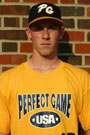 Anthony DeSclafani – RHP
In
high school, Anthony DeSclafani was a long and lean 6-foot-3,
175-pound righthander from New Jersey with a very long and loose arm
action and easy release that was very easy to project. He pitched in
numerous WWBA tournaments in 2007-2008 for the South Florida Bandits
and the Tri-State Arsenal and was a regular on the 2007 summer
showcase circuit, including throwing at the 2007 Perfect Game
National Showcase. His report from that event read:
He
has a slender, young build and hasn't started to get strong yet.
DeSclafani has a low effort delivery and very long and loose whippy
arm action and an extended mid 3/4's release point. He threw a 4 seam
fastball that topped out at 92 mph and a 2-seamer that had nice sink
and run at 87 mph and was able to throw both pitches to spots low in
the zone. With his loose and easy arm, DeSclafani projects more
velocity in the future. His slider and change up are still in the
developing stages. Like many pitchers with similar arm
actions/release points, getting a feel for a breaking ball is
difficult and DeSclafani's slider is soft with an early break. With
his easy delivery, long arm action and lack of off speed pitches, he
lacks deception right now.
DeSclafani
would flash a better breaking ball at times for scouts but didn’t
develop any consistency with it during high school and was a primary
fastball pitcher. When his fastball stayed in the 88-92 mph range as
a senior, the Red Sox made him a 22nd
round draft pick in 2008 before DeSclafani headed south to attend
Florida.
The
Gators used DeScafani as a starter early in his career in Gainesville
but realized eventually that with one plus pitch that he had
outstanding command of, the now low to mid-90s sinking fastball, that
DeSclafani had more value in the bullpen than in the starting
rotation. He went 5-3, 4.33 with six saves as a junior in 2011,
striking out 39 hitters in 43 innings and only issuing three walks,
leading to him being selected by the Toronto Blue Jays in the sixth
round of the draft that year. He was part of the huge salary dump
trade with the Marlins that sent Jose Reyes, Mark Buerhle and Josh
Johnson to Toronto in November, 2012.
DeSclafani
has been a starter since the signed professionally, and according to
the Baseball Prospectus scouting reports, the Blue Jays and Marlins
development staffs have been able to finally coax at least a MLB
average slider and an improved changeup out of the long arming
righthander. – David
Rawnsley
Philadelphia
Phillies
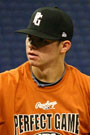 Jesse Biddle – LHP
Much
of the evaluation of Jesse Biddle from his high school days has
remained true to form, almost as if the Phillies have let him develop
in his own vacuum. That is not necessarily a bad thing.
Biddle,
who grew up and went to high school at Germantown Friends Academy, a
Quaker institution in suburban Philadelphia, had a very symmetrical
development curve as a teenager. He first started throwing at WWBA
events for the Philadelphia Senators team coming out of his freshman
year in 2007 and generally topped out at 83-84 mph with a big mid-60s
curveball at that age. His arm action was long and loose, with some
cross-body action at release that was noted from his first scouting
reports and has remained with him since. He gradually bumped that up
to the 87-88 mph range coming off his sophomore season and was up to
89-92 during the summer before his senior year. What really garnered
him attention, and his eventual first round status (27th overall) by his hometown Phillies, was topping out at 94-95 mph
during the spring of his senior year.
He
has taken pretty much the same development path since signing as
well, with the slight downtick in velocity as a professional due to
the workload of pitching every fifth day.
A
couple of things have always stood out about Biddle from the
beginning of his time on the national stage, starting with the
Perfect Game National Showcase in 2009:
•
His curveball has
always been a big and deep, but a relatively slow pitch, topping out
at 71-73 mph in high school. It’s not a power pitch, but it is one
that he commands effectively and its size and plane make it hard to
square up.
• It
has always seemed to this scout that Biddle’s arm action is highly
conducive to a slider or a cutter but that hasn’t happened yet. My
notes have frequently made mention of that potential and a comp with
the recently retired Andy Pettitte. It wouldn’t be surprising if
Biddle eventually developed a Pettitte-type cutter.
•
The
other thing that Biddle has consistently done is induce
swing-and-miss tendencies in hitters without an obvious
swing-and-miss pitch. Hitters at elite events in high school swung
through far too many 88-89 mph fastballs to not know as a scout that
there was some serious deception happening, even though it wasn’t
readily obvious where it was coming from. The same thing has happened
at the professional level as well.
•
Biddle
has always drawn very positive comments from scouts and coaches for
his quiet confidence and positive mature makeup. That seems to still
be the case today.
– David Rawnsley
New
York Mets
Kevin Plawecki – C
Plawecki
played in a pair of WWBA National Championships in consecutive years
for the Indiana Dirtbags while in high school, starting with the 16u
in 2007 and following with the 17u in 2008. Although his power
potential was evident, hitting a towering home run to the pull-side
at the 17u event, his catching skills were considered to be well
ahead of his bat.
Here
is a collection of scouting notes from those two events:
Tall
athletic frame … quick footwork and release, 2.04, 2.07, 2.09 (Pop
times), good catch and release, throws easy, good soft receiver …
easy swing, long bomb down LF line, hustles, hands inside ball,
balanced, nice stick.
At
Purdue he grew from 5-foot-11, 165-pounds to 6-foot-1, 215-pounds
while in college, and not only did he consistently tap into his
considerable power potential more often, but he also matured into a
vocal team leader behind the plate.
Here's
his PG scouting report prior to the 2012 MLB Draft:
When
Plawecki enrolled at Purdue, he was considered a defensive-minded
catcher with the potential to develop into a middle-of-the-order run
producer. His bat definitely has stepped forward as he now has a very
sound approach to hitting, and the ability to consistently square up
balls and drive them to the gaps. His power continues to emerge in
concert with his improvement as a hitter … He shows good lateral
movement and improving blocking skills, and his quick release
overcomes the lack of ideal arm strength for the position.
It
should be noted that Plawecki was part of a very promising draft
class during his junior year at Purdue that included third baseman
Cameron Perkins (sixth round, Phillies) and righthander Nick Wittgren
(ninth round, Marlins), and is further proof of the increased talent
coming out of the Indiana high school and college ranks in recent
years. – Patrick Ebert
Brandon Nimmo – OF
As
has been well documented, Brandon Nimmo has one of the most unusual
backgrounds of any top prospect in baseball.
He
grew up in Cheyenne, Wyoming, a state that doesn’t have high school
baseball. He played for American Legion Post 6, a regionally
prominent program, hitting .448-16-84 with 34 stolen bases in 70
games during the spring and summer of 2010. And while Nimmo did have
short appearances on the national stage, including the 2010
Tournament of Stars and a four-day team-funded spring break trip to
Arizona in 2011, scouts had to primarily travel to Wyoming and South
Dakota to see and evaluate Nimmo. It was the first time that many of
those road warriors had ever been to one or either of those states.
Despite
those obstacles, Nimmo was selected with the 13th overall pick in the 2011 draft and signed for a $2.1 million bonus.
He became the highest Wyoming high school age player ever drafted,
easily surpassing righthander Michael Beaver, who was the Phillies
sixth round pick back in 1966.
(The
University of Wyoming, which no longer has a baseball team, produced
fourth round outfielder Bill Ewing in 1976.)
Nimmo’s
sweet lefthanded swing, his combination of power and speed and his
projected ability to stay in center field all contributed to his
being evaluated as a first rounder by many teams in addition to the
Mets. This occurred despite the nagging reality that he had never
faced quality competition over an extended length of time, or had
rarely been evaluated against that level. Nimmo also had an injury
background, having torn his ACL before giving up football in 2009,
which didn’t keep him from winning the state 400 meter championship
as a senior at 51.45 seconds.
Mets
Vice President of Player Development and Scouting Paul DePodesta said
in an MLB.com article after the 2011 draft, “This certainly isn’t
without risk. But as we went into this, to be quite frank with you,
we weren't that interested in making what we thought was the safest
pick. We were interested in making the pick that we thought had the
chance to make the most impact."
Hindsight
is always 20/20 of course, and Nimmo still has plenty of time to
develop into an impact Major League outfielder. However, the Florida
Marlins picked immediately after the Mets in 2011 and selected
another high school player with a high perceived risk level due to
his unusual background, Jose Fernandez. –
David Rawnsley
Washington
Nationals
 Lucas Giolito – RHP
Lucas
Giolito’s Hollywood background, prodigious talent and his
frustrating and ill-timed elbow injury have combined to make him
perhaps the highest profile high school pitching prospect of the last
decade.
He
is the son of long-time television actress Lindsey Frost and video
game executive (EA, Trilogy Studios) Rick Giolito and comes from an
extended Hollywood family. Although he was very young for the 2012
class and could have easily been a 2013 based his birthdate – he is
two months older than Kohl Stewart and three weeks younger than Trey
Ball, the first two high school pitchers selected in the 2013 draft –
Giolito grew to his present 6-foot-6, 230-pounds early and never
experienced any young oversized awkwardness athletically.
Giolito
made his first appearance on the national stage at the 2010 Area Code
Games shortly before the beginning of his junior year at
Harvard-Westlake High School. As one of the few underclassman in Long
Beach, he wowed the scouts, topping out at 96 mph with a 78 mph
curveball. The Perfect Game notes from that event reflected that:
++
build for age, could be a 2013 with his B/D, slow paced delivery,
hand drop set, long loose arm, warms up at 91-93, + fast arm, limited
feel for off speed, CB spin not tight, not wild but not throwing to
spots, very young but very, very good.
Giolito
didn’t really gain much velocity over the next year, not that he
really needed to. He couldn’t attend the Perfect Game National
Showcase due to a prior commitment, but threw at the PG Sunshine West
Showcase the previous week and also pitched at the 17u WWBA National
Championship for the San Gabriel Valley (SGV) Arsenal, the Area Code
Games again and topped off his summer by hitting 97 mph at the
Perfect Game All-American Classic, starting the game for the West
squad.
The
big difference in Giolito’s stuff, though, was the development of
his curveball. It went from a mid- to upper-70s pitch with limited
feel to an 82-84 mph hammer with plus/plus potential. Part of my
notes from the 2011 Area Code Games read:
Throws
+ easy, for all his velo CB is potentially a better pitch, scouts
rave on CB,
Young approach but #1/#1
talent.
The
intrigue continued to grow for Giolito’s senior season. First,
fellow PG All-American SoCal top prospect Max Fried decided to join
Giolito at Harvard-Westlake after his previous high school
discontinued their baseball program, giving the school perhaps the
best pitching duo in the history of high school baseball. Fried would
end up being the seventh overall selection by the Padres in the 2012
draft.
Secondly,
the bump in velocity that most scouts had been expecting from Giolito
happened, as he was clocked at 100 mph in pre-season scrimmages by
numerous scouts. With no obvious No. 1 pick already established for
the 2012 draft, there was already talk that Giolito could become the
first high school righthander ever selected first overall. He
certainly seemed worthy of it.
Of
course, everything unraveled quickly from there, as Giolito sprained
his ulnar collateral ligament in his right elbow in another scrimmage
and missed the entire spring while rehabbing the injury. He was the
big wild card in the 2012 draft that saw Carlos Correa and Byron
Buxton go Nos. 1 and 2 and was eventually selected by the Nationals
with the 16th pick and signed for a $2.925 million bonus despite not having thrown
competitively in five months. –
David Rawnsley
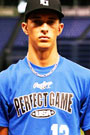 A.J. Cole – RHP
Andrew
“A.J.” Cole has always come about his velocity pretty easily and
was already throwing Major League velocities coming out of his
freshman year at Oviedo High School in Florida. He came to the 2007
Perfect Game Junior National Showcase as a 6-foot-4, 180-pound 15
year old and threw steadily in the 88-90 mph range with an upper-70s
slider.
His
notes from that event read as follows:
Easy
arm, little hitch on backside, 3/4 arm slot, solid mechanics, good
sink, held velocity from stretch, worked runners, good pitchers body,
makings of a thick trunk with maturity, located FB and SL to both
sides of plate, good hard SL, showed some ASR, fielded position well,
good composure and presence.
Cole
would continue to gradually improve and fulfill his young projection
through the remainder of his high school days. His velocity moved up
to 90-93 in the summer of 2008 while pitching for the Orlando
Scorpions and was steadily in the mid-90s, topping out at 98 mph at
the 17u WWBA National Championship in July of 2009. He was named a
Perfect Game All-American and pitched in the 2009 PG All-American
Classic.
Two
things at that point kept scouts from going completely all in on Cole
despite the easy plus/plus velocity and the profile pitcher’s build
and looseness. First, while his breaking ball would flash hard spin
and bite, it wavered between slider and curveball shape in the
upper-70s and was never a consistent potential plus offering.
Secondly, Cole showed good control of his fastball in terms of
throwing strikes but had below average command, as he was often up in
the strike zone and straight. Hitters got better swings at times off
Cole than one would expect given his raw stuff.
Cole
went into the 2010 draft ranked seventh in the 2010 high school class
by Perfect Game and was expected to be a first round draft pick.
However, concerns about his signability and scholarship to Miami
caused Cole to slide out of the first round and he was eventually
selected by the Nationals in the fourth round.
Given
that the new draft slot guidelines had Cole’s slot listed at
$258,000, the Nationals at the time didn’t have a reputation for
overspending, and that they were believed to be mustering all their
resources for their first pick, No. 1 overall selection Bryce Harper,
it seemed like a strange place for the hard throwing high school
righthander to land.
But
the Nationals carried the day, not only signing Cole for a fourth
round record $2 million bonus, but of course getting Harper into the
organization as well.
– David Rawnsley
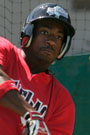 Brian Goodwin – OF
Goodwin's
talents were well known in high school, as he was named to the 2008
PG All-American where he garnered MVP honors by hitting the go-ahead
two-run single in the top of the ninth inning at Dodgers Stadium.
Overall in that game he was 2-for-4 with a double, and also scored an
insurance run in the final frame.
Leading
up to the 2009 draft he was ranked the 34th best high school player in the nation, although Goodwin's commitment
to North Carolina caused him to slide to the 17th round where he was taken by the White Sox, a team that is known to
covet premium athletes such as Goodwin.
Goodwin
played at a handful of PG/WWBA tournament events with his home-state
Dirtbags, including back-to-back World Championships in Jupiter, Fla.
in 2007 and 2008. His five-tool talents were easy to see on the
baseball field, with game-changing speed, an impact bat from the
lefthanded batter's box and the ability to pitch in the mid-80s off
the mound. Most of his power was to the alleys at the time, but due
to an aggressive approach and good natural strength more
over-the-fence power was expected to emerge as he continued to fill
out his 6-foot-1, 190-pound frame.
His
polished profile in high school led to him enjoying immediate success
during his freshman year for the Tar Heels, although he spent only
one year there prior to transferring to Miami-Dade College for his
sophomore year after he was suspended for violating team policy at
UNC. While this made him eligible for the draft a year earlier than
if he had remained at North Carolina, it also led to some
off-the-field questions.
Goodwin’s
superior athleticism and maturing baseball skills make him an obvious
first-round candidate, no matter what the draft year. He has all the
raw tools to excel in the big leagues, and his combination of hitting
skills, emerging power, superior speed and stellar defense makes him
one of the best all-around outfield prospects in the 2011 draft.
Goodwin is a 6.5-second runner with outstanding range in center
field. He also has one of the top outfield arms in the class.
Offensively, Goodwin has a quick, effortless lefthanded swing and
stays inside the ball with a level, line-drive type swing. His raw
strength enables him to generate bat speed and drive balls into the
gaps, although his present approach at the plate limits his loft
power … Goodwin is far from a finished product, however, and scouts
say he’ll need to continue to refine both his approach at the plate
and defense in center field. More than anything, he needs to develop
more consistent breaks on balls hit his way in order to settle in as
an everyday center fielder.
The
Nationals, another organization that has valued impact overall
athletes in recent years, took Goodwin in the supplemental
first-round of the 2011 draft.
– Patrick Ebert
Atlanta
Braves
 Lucas Sims – RHP
Sims,
a Georgia native, began his high school career as a primary shortstop
who also pitched. He attended his first showcase, the 2011 PG
Southeast Underclass Showcase, as his sophomore year at Brookwood
High School began. During the infield workout the 15 year old Sims
threw 92 mph across the infield from shortstop with a lot of
movement. The next day he took the mound and sat 88-90 with that same
movement and it became quite obvious where his future would be on the
baseball diamond.
Wisely,
Sims technically remained a primary infielder until the summer after
his junior year of high school, limiting the mileage on his arm until
his final draft evaluation year arrived. He was a relatively advanced
prep arm despite dividing his efforts, showing good command of his
fastball when working in the 90-92 range, and several ticks higher
whenever he decided to reached back for more. He registered as high
as 97 mph with his fastball at the East Coast Pro Showcase. He didn't
just flash velocity in showcase settings though, he touched 96 in
multiple WWBA tournaments where he continued to play for his hometown
Team Gwinnett, rather than leaving them for an all-prospect
conglomerate team.
Beyond
the velocity, Sims' curveball showed good potential, with sharp break
and a hard spin rate, one of the primary indicators scouts look for
when projecting breaking balls. His changeup was ahead of the
developmental curve as well and he showed a consistent ability to
compete in tough spots and make necessary in-game adjustments
throughout his amateur career.
His
success the summer prior to his senior year, which began with an
appearance at the 2011 National Showcase in Fort Myers, Fla., reached
its pinnacle at the PG All-American Classic, where he took the mound
in the second inning for the East squad. At both events Sims'
fastball peaked at 94 mph.
Sims
came into his senior spring as a viable first round candidate, but in
a very deep 2012 high school class he was seen as a bubble candidate
for the first round. As it turned out his hometown Atlanta Braves,
who built a dynasty around drafting and developing pitching,
particularly from players plucked up from their own backyard, tabbed
Sims with the 21st pick.
– Todd Gold
 J.R. Graham – RHP
Perfect
Game’s Allan Simpson wrote the following draft profile for Graham
prior to the 2011 draft. It summarizes Graham’s amateur years well
and sets the stage for his somewhat ironic professional career thus
far.
Even
with his slight frame, Graham has one of the most-electric arms in
this year’s draft class. His fastball reached 97-98 mph this spring
as a matter of routine, and often peaked out at 100. For a time, it
looked like Graham’s overpowering fastball alone would vault him
into the first round, especially when he didn’t walk a batter
through his first 12 relief appearances, spanning 24 innings. At the
time, he had no walks and 26 strikeouts.
But
Graham’s performance started to level off after he made a rare
start in the final game of Santa Clara’s West Coast Conference
season-opening, three-game series against Loyola Marymount on April
10, when he was rocked for eight runs in five-plus innings, and
walked his first batter of the season. With Santa Clara posting just
a 17-32 record (4-15 in conference) this season, save opportunities
were tough to come by for Graham, and he ended up making three more
starts to get in some meaningful innings. Overall, he went 3-4, 3.54
with four walks and 41 strikeouts in 53 innings.
As
the season wound down, most of the talk about Graham going in the
first round had pretty much subsided, and the consensus among scouts
is that he’ll be a second-rounder, though could possibly slip into
the sandwich round. Graham is highly athletic and very competitive,
but his issue as a prospect has always revolved around his big
arm—and small, wiry frame.
As
a senior in high school, Graham weighed only 165 pounds, but had
little trouble reaching 92 mph and showcasing his impressive arm
strength from the hole at shortstop. He was a solid two-way prospect
at the time, with speed (6.68 in the 60) and sound infield actions,
and actually saw significant time at third base in his first two
seasons at Santa Clara. But when he struggled to hit at the college
level, and it was becoming increasingly clear that his future was on
the mound, Graham settled in as a closer for the Broncos over the
latter part of the 2010 season.
In
23 appearances, he saved four games while going 1-1, 5.27. During the
summer in the Northwoods League, Graham focused on pitching and
earned strong reviews for his quick arm and ability to pound the
strike zone with easy 92-94 mph velocity. By this spring, Graham had
jacked up his velocity another 4-5 mph. Though he also has a quality
slider and changeup, giving him the three pitches he would need to
work as a starter, Graham’s startling performance this spring in an
end-of-game role, where he has been able to air out his fastball
almost exclusively, has left little doubt in the minds of scouts that
his future role is at the back end of the bullpen.
Evidently,
the one organization that had doubts in their minds about Graham’s
future role as a backend bullpen guy was the Braves, who grabbed him
when Graham unexpectedly slid to the fourth round and immediately
transitioned him to a full-time starter’s role.
– David Rawnsley
 Jason Hursh – RHP
Jason
Hursh came to the Perfect Game Sunshine South Showcase in early June,
2009, after his junior year as a primary shortstop and secondary
outfielder. He ran a 6.96 60-yard dash and showed plus arm from both
shortstop (91 mph) and the outfield (93) but did not grade out nearly
as well as a hitter, grading out at 7.5/7 on the Perfect Game
scouting scale that goes up to 10. With that in mind, the PG scouts
at the event asked Hursh if he would like to throw an inning on the
mound on the event’s second day. He readily agreed.
It
was a very good decision, as Hursh threw in the 89-91 mph range and
did it easily with simple mechanics. He was immediately invited to
the PG National Showcase two weeks later and duplicated his
performance while adding a mid-70s curveball that showed some promise
once his young mechanics become consistent. He reaffirmed in batting
prospect that he wasn’t a next level hitter and showed all the
colleges in attendance that he was a top level pitching prospect.
Armed
with a 4.0 plus GPA in addition to a fastball that started peaking in
the 93-94 mph range during his senior year (11-2, 2.47, 123
strikeouts in 70 innings), Hursh bypassed a sixth round selection by
the Pittsburgh Pirates in the 2010 draft to attend Oklahoma State.
After
an uneventful freshman season, Hursh tore an elbow ligament pitching
in the Cape Cod League in the summer of 2011 and had to sit out the
entire 2012 spring season after undergoing Tommy John surgery. He
recovered quickly and had already returned to the mound by that
summer, showing a steady mid-90s fastball in the California
Collegiate Summer League.
Early
in the spring of 2013, Hursh was one of hottest commodities on the
scouting circuit, regularly topping out at 97-98 mph and showing very
good command of his heavy sinking fastball. His slider and changeup
were workable but not advanced secondary pitches, however. As Hursh
lost some velocity and the edge on his command under a heavy workload
at Oklahoma State (16 starts, 106 innings) he lost some of his luster
in scout’s eyes but was still selected by the Braves with the 31st
overall pick, receiving a $1.7 million signing bonus.
Yes,
Hursh would have probably figured out at some point that his career
was on the mound if he had declined to throw an inning that morning
in Brenham, Texas in 2009. But it still was a very good spur of the
moment decision.
– David Rawnsley